Conditional support for SRM research
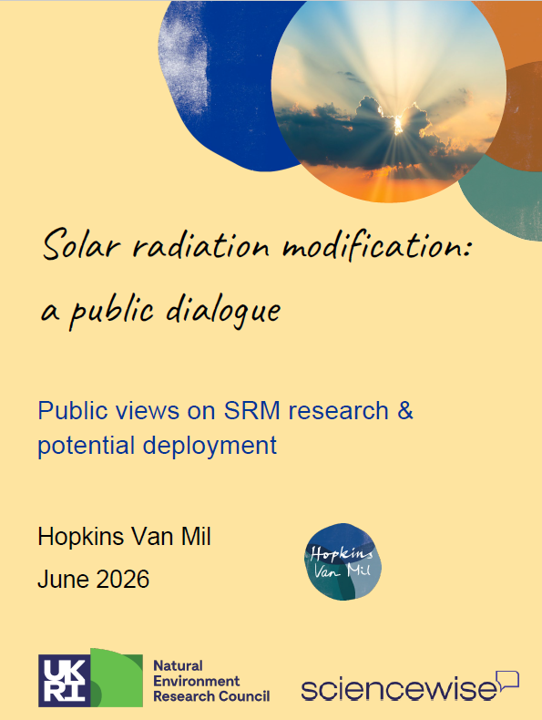
In the last week the UK has experienced record breaking temperatures for May with widespread impacts on both daytime and night-time temperatures. And so it seems significant that today the Natural Environment Research Council (NERC) and Sciencewise are publishing the findings report on the public dialogue on Solar Radiation Modification (SRM) designed, delivered and reported on by HVM.
In the autumn of 2025 HVM supported 52 participants to explore the complex and contentious issue of Solar Radiation Modification (SRM). SRM refers to a range of ideas that propose to cool the planet largely by reflecting sunlight away from the Earth. As current climate mitigation efforts have not kept global temperatures below critical thresholds, SRM has emerged as a potential intervention, though it remains highly contentious with significant scientific uncertainty.
We found in our work with participants that they broadly support further research into SRM, particularly computer modelling, provided it:
Is carried out within a robust ethical framework;
And, very importantly, does not distract from efforts to reduce greenhouse gas emissions.
While participants saw the value of research, some urged caution about large scale deployment and stressed SRM should not distract from addressing the root causes of climate change. As part of this process participants developed six core principles they believe should guide SRM research, with some also relating to any future SRM deployment. They can be found within the report.
Postcode Films worked with HVM to create a vivid account of participant and stakeholder reflections on the dialogue, and the topic.
Thanks to all the public dialogue participants who deliberated on this topic for over 17 hours in workshops and in an online space. They were endlessly impressive in their commitment to weighing up all the evidence and developing thoughtful and considered principles for SRM research.
It has been a pleasure to design, deliver and report on this fascinating public dialogue. Working with the NERC, Sciencewise and the independent evaluation team at URSUS Consulting, as well as the oversight group chaired by Prof. Jack Stilgoe has been a great experience.
The programme demonstrates again that people from across society can and do meaningfully engage with extremely complex scientific subjects, with wide-ranging ethical dimensions, when given time and access to robust evidence delivered through exchanges with specialists in the field. And that this work leads to findings with the potential for significant impact for future SRM research, policy, and decision making.