What was the public dialogue?
HVM was commissioned by the Department for Science, Innovation and Technology (DSIT), with support from UK Research and Innovation’s Sciencewise programme to design and deliver a public dialogue on the governance of engineering biology (EB). The dialogue findings and recommendations are now being taken forward by the Department for Business, Innovation, Science and Trade (BIST).
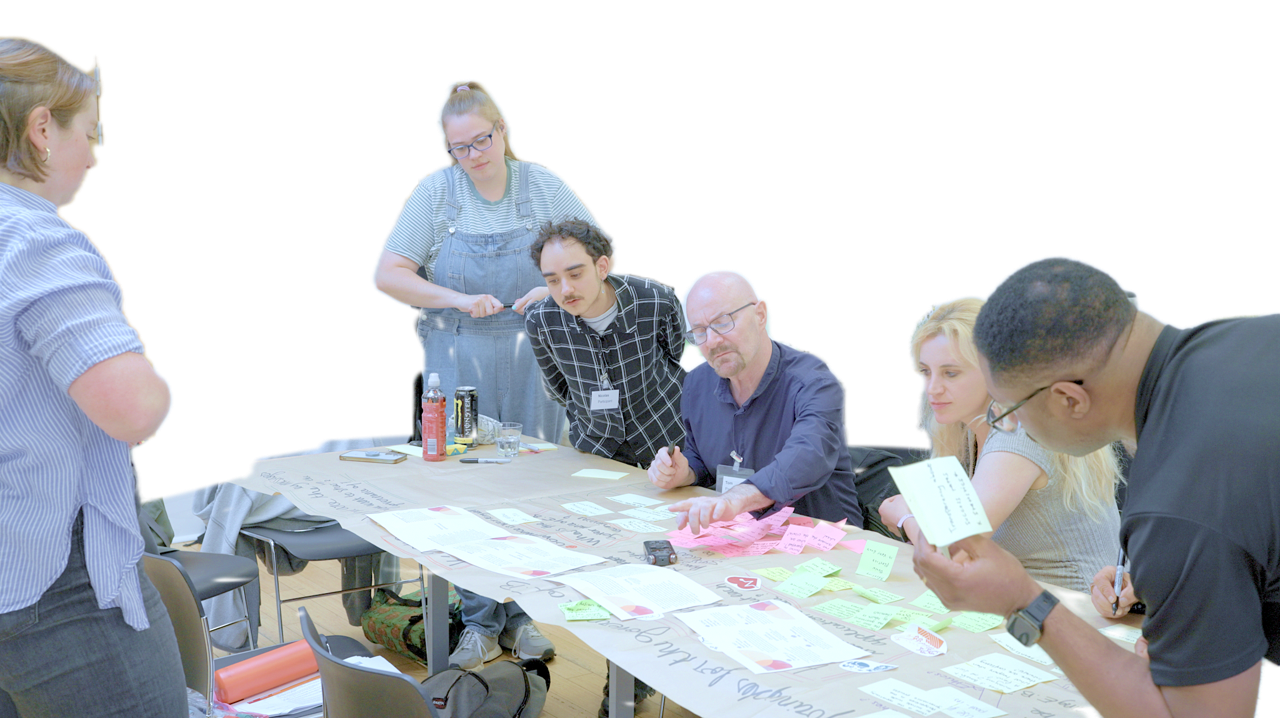
The HVM team were fortunate to be able to listen to the views of 56 participants, broadly reflective of the UK population who were able to have in-depth and meaningful conversations over time on what the implications for governance of the adoption of engineering biology should be in the short, medium and long-term. Participants worked together in online and in-person workshops to explore their:
Public hopes and concerns for EB, including the role they think members of the public should play in the ongoing governance of EB;
Beliefs and overarching principles for the governance of EB;
Views on how to define responsible innovation in EB in practice, and how it should be ensured to promote trust in EB products and processes;
Red lines on EB innovation.
Participants’ vision for EB
Participants were excited about EB and its opportunities. They also pointed to past governance failures and earlier technologies that had appeared exciting but ultimately caused serious problems for society. Their support was conditional on four things:
Public benefit coming first;
A proactive and rigorous approach to risk;
Early and consistent public involvement;
Honesty and transparency.
They expressed a great deal of hope for EB if those conditions could be met, particularly for applications that improve health and combat climate change. They saw the EB as a way of tackling some of society’s biggest challenges and wanted scientists, researchers and government to be ambitious and bold. Some hoped the UK could become a global leader, building on the strength of its universities.
Their greatest worries for EB were about unintended consequences, particularly the uncontrolled release of engineered organisms and long-term effects on health. Food and agriculture raised the most concern, especially for farmers and rural communities, food safety and people’s choice over what they eat. Participants wanted reassurance that EB will not become another solution that creates its own problems, as they felt had already happened with plastics and pesticides.
A key message from this dialogue is that people must be involved in every aspect of EB development. Given time, good information and respect, the public will engage seriously with complex science and reach considered views. As one participant put it,
“Technologies are nothing without the people they’re applied to.” Workshop 4, Norwich
Government and everyone working in EB now has the chance to show that this dialogue was not a one-off, but the start of a lasting and fruitful partnership.
Postcode Films have created a public dialogue film highlighting the key findings from the dialogue. HVM was so pleased to work on this fascinating public dialogue in a complex area of science leading to really nuanced public dialogue findings. We are grateful to all the dialogue participants who embraced the deliberative process so whole-heartedly, and the 18 specialists who shared evidence with participants, ensuring rich conversations on the governance of EB.